



 to add an item to your Itinerary basket.


A new exhibition at The Bingley Gallery sees the Aire Valley Arts group explore the transformative relationship between poetry and visual art. Each artist has selected a poem as a starting point, interpreting its themes, imagery, and emotional tone through their chosen medium. The result is a diverse and engaging exhibition that highlights both individual creativity and the shared expressive language between art forms.
Aire Valley Arts is a long-established collective of professional and semi-professional artists, centred around Bingley but with members stretching from Lothersdale to Leeds and Wharfedale. Recently celebrating its thirtieth anniversary, the group encourages experimentation and creative risk-taking. While themed exhibitions are typical, this show takes a more open approach, asking each artist to respond to a poem in their own way and medium.
Founding member Jane Fielder is known for her distinctive watercolours of local neighbourhoods, often with a trademark clothes line hidden within it. In this exhibition, the washing line becomes the focal point. Her work is inspired by a humorous poem by Marilyn K. Walker, in which a newly married woman hangs out bright pyjamas to conceal the fact that her husband prefers to sleep unclothed. Fielder’s piece captures both the wit and quiet social observation of the poem.
New member Ben Snowden brings an expressive style focused on the human form and its connection to nature. His use of bold colour and dynamic line creates emotionally charged compositions that blend identity with natural elements. Through drawing and painting, Snowden presents an optimistic and thoughtful view of the world.
Helen Shearwood, now based in Western Australia, continues her involvement with the group. Beginning with photographs of overlooked subjects such as weathered posters or fragmented signage, she enhances them to reveal unexpected beauty. Her work aligns with The Patience of Ordinary Things by Pat Schneider, reflecting on the quiet stability found in everyday surroundings. Shearwood’s approach invites viewers to slow down and rediscover meaning and beauty in the ordinary, especially in uncertain times.
Caroline Hardaker contributes two evocative landscapes inspired by Ted Hughes’ poem Moors. Interestingly, Hughes himself originally wrote the poem in response to photographs by Fay Godwin, creating a layered dialogue between visual and literary inspiration.
L Amy Charlesworth says she hates poetry but found some to fit with her artwork including a short verse on a blue tit by Paul Curtis.
Karen Harman, known for her sensitive animal portraits, draws on Mary Oliver’s Little Dog’s Rhapsody in the Night. Her work captures the emotional bond between humans and animals, with particular attention to expression and character.
Leeds-based artist Paul Hudson, who is also a poet, presents three works accompanied by his own verses. His pieces explore themes of spirituality, seasonal change, and the passage of time. One example, Hare, evokes the turning of winter into spring through rhythmic and symbolic imagery.
Judy Sale’s work reflects her passion for environmental issues and human equality. A former US citizen, she experienced the loss of her physical voice during a difficult citizenship process, but continues to express herself powerfully through art. Her mixed-media piece Fire and Ice, inspired by Robert Frost’s poem, explores the fragility of the planet and the urgency of its protection.
Sue Strange, based in Lothersdale, finds inspiration in Wendell Berry’s The Peace of Wild Things. Her landscapes reflect a search for calm in a chaotic world. One painting depicts Styhead Tarn in the Lake District, a long-time favourite landscape, while another captures St Aidan’s Nature Park near Leeds, a reclaimed industrial site. Both works emphasise the restorative power of nature.
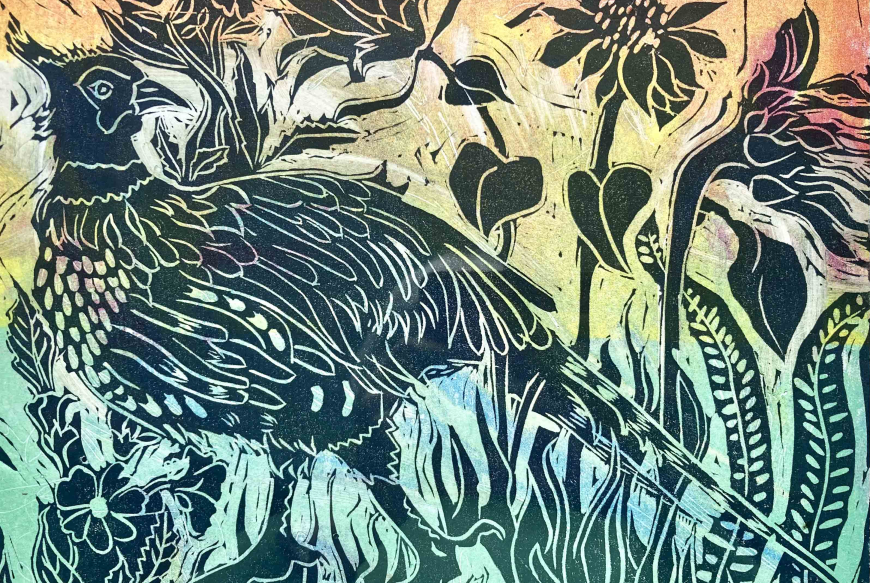
Jan Whittock draws inspiration from her immediate surroundings, particularly her garden. Her imagery of plants and birds connects with lines by Sylvia Plath describing a pheasant moving through long grass. Currently working in printmaking, Whittock experiments with techniques such as etching, lithography, and lino printing, enjoying the variety these processes offer.
Nancy Stedman mentioned her initial uncertainty before discovering a short but evocative poem by Edward Thomas. Inspired by its delicate depiction of seasonal change, she developed a piece imagining a rook’s-eye view of the landscape. Her method involves layering paint, texture, and collage, allowing the image to emerge gradually rather than following a fixed plan.
The exhibition’s strength lies in its variety. Some artists closely follow the imagery or narrative of their chosen poems, while others respond more abstractly, focusing on mood and atmosphere. Together, the works create a rich dialogue between visual and literary art.
Ultimately, this exhibition reflects the collaborative spirit of Aire Valley Arts. While each piece stands alone, collectively they form a thoughtful exploration of how poetry can inspire new ways of seeing. Visitors are encouraged not only to look more closely at the artworks, but also to reflect on how visual interpretation can deepen our understanding of words.
The Exhibition will be launched on Weds 29 April and will then run until 17th May.
Related

A new exhibition exploring how members of Aire Valley Arts interpret poetry through painting, printmaking, mixed media, and photography.
The Bingley Gallery is a welcoming, artist-run, venue which exhibits, and sells, a wide range of art work from the region's talented artists.
Comments
Comments are disabled for this post.