



 to add an item to your Itinerary basket.


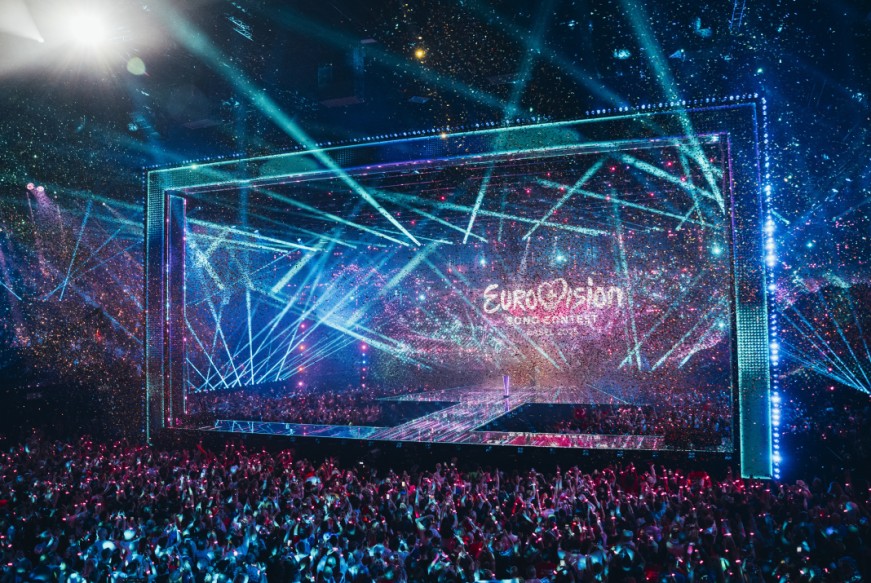
Image by Sarah Louise Bennett
The National Science and Media Museum will unveil an exciting new temporary exhibition Setting the Stage: 70 Years of the Eurovision Song Contest this May. Coinciding with the 70th anniversary of the Eurovision Song Contest, the exhibition will explore the technological history and innovation at the heart of the world’s largest live music event that has contributed to its enduring legacy today.
Opening on Friday 8 May and running until February 2027, the exhibition tracks the innovations behind the broadcast, taking visitors on a journey from its early formation to its wide-ranging impact today. From pioneering early broadcast technology to the staging, lighting and production techniques that have come to define the competition as much as the music itself, the exhibition charts the evolution of the Eurovision Song Contest.
These advances have not only shaped the Contest but also driven innovation in broadcasting worldwide, notably through initiatives such as large-scale televoting, transforming how audiences could participate in live television and changing how live events can engage viewers from across the globe. The Contest has also been at the cutting-edge of dynamic LED staging technology, allowing for spectacular visual performances on a scale never-seen before.
The exhibition will feature a series of interactive displays, allowing visitors to get hands-on with the groundbreaking technologies at the centre of the Contest. An interactive Nil Points Jukebox, will invite visitors to better understand voting technology, giving them the opportunity to cast their vote to rank the competitions most iconic “zeroes”. The interactive offers an entry point into one of the Contest’s most debated features; the voting system and its relationship to broader global relations. By revisiting performances that received few or no points, this exhibit considers how voting outcomes, shaped by audience participation and wider dynamics of influence within the Contest, have shaped its legacy.
Charting the Contest's journey to becoming the world’s largest live music event, the exhibition will also shine a light on the people behind the show, whose creativity and collaboration have shaped its technological evolution. Objects on display include a Marconi Mk III camera head, part of the early TV-broadcast technology that made early transnational broadcasts like the Eurovision Song Contest possible, and a Shure Duraplex headset, powering the Contest’s high-octane dance routines by allowing performers to move freely.
These technologies are brought to life elsewhere in the exhibition through a dedicated performance space. Here, visitors are invited to take to the stage themselves and perform from a selection of Eurovision Song Contest hits. The space brings together the performance and production elements that define the Contest and have helped to shape its identity as a global broadcast phenomenon.
The exhibition will also centre the people at the heart of the Contest’s global impact, with content from the fans and professionals who have shaped its story. This will include iconic outfits from hosts and performers, a range of fan-made ephemera from the Eurovision Song Contest’s global community, and memorable moments captured through specially commissioned and archive video footage.
Jo Quinton-Tulloch, Director of the National Science and Media Museum commented: “We are delighted to be opening our new temporary exhibition, Setting the Stage: 70 Years of the Eurovision Song Contest, later this year. For seven decades, the Contest has consistently pushed the boundaries of what live television can achieve by embracing the most advanced technologies.
As one of the biggest live broadcast events in the world, reaching 166 million global television viewers in 2025, the science and innovation behind the Contest has underpinned its growth from a post-war experiment into a global brand, helping to shape modern broadcasting as we know it today. We can’t wait to welcome visitors behind the scenes of this extraordinary Contest and see how technology brings the party to millions of homes worldwide.”
Martin Green, Director of the Eurovision Song Contest at the European Broadcasting Union added: “As we mark 70 years of the Eurovision Song Contest, we’re excited to support the National Science and Media Museum with this special exhibition. Setting the Stage beautifully captures not only the music and magic audiences see on screen, but also the extraordinary innovation, creativity and collaboration behind the scenes. The Eurovision Song Contest has always been about bringing people together - across borders, generations and cultures - and this exhibition offers a unique opportunity to explore how technology and talent have combined to make that possible. We hope it inspires visitors to see the Contest in a new light and to celebrate the many people who continue to make it such a powerful global event, United by Music.”
Following the Second World War, public service broadcasters came together to establish the European Broadcasting Union (EBU) in 1950. Its aim was to support public service television development, as well as radio technologies and programming, connecting post-war Western Europe together with live simultaneous content, sharing both cost and technological advances. Following a period of initial experimentation, including overcoming physical barriers such as the Swiss Alps and English Channel, as well as incompatible broadcasting systems, in 1956 the Eurovision Song Contest was born.
First staged with just seven participating countries, the Eurovision Song Contest has since grown into one of the world’s largest live music events, including up to 43 participating broadcasters in recent years, reaching audiences of hundreds of millions worldwide on TV and latterly on social media. Across its seven decades, the Contest has seen landmark moments of cultural change and broadcast innovation, from the transition to colour television and satellite broadcasting to ABBA’s career-launching victory in 1974.
While the exhibition maintains its primary focus on the evolution of the Eurovision Song Contest’s technology and production, an associated public programme will explore the broader history and impact of the Contest, including themes like music, performance, stagecraft and careers in broadcasting. This offer will provide visitors of all ages with opportunities to engage more deeply with the technologies that continue to transform how we create, share and experience live broadcast events.
Keep an eye on the website for the latest information.
Related

The National Science and Media Museum, in the heart of Bradford, explores the science and culture of light and sound technologies and their impact on our lives.
Celebrating 70 years of Eurovision at the National Science and Media Museum. Go behind the sequins of the world’s largest live music event and discover how the magic really happens.
Unleash your inner pop star over the summer holidays with creative activities for all ages at the National Science and Media Museum.
Comments
Comments are disabled for this post.